Wednesday, October 28, 2009

Innocence or Ignorance?


       Recently in class we had a discussion on doublespeak (or disguising a word with a bad connotation under the seal of a word with a better connotation, such as the USA Patriot Act for "Were gonna invade your privacy and listen to all your conversations" Act. As I tried to think of an example I could blog about, I realized that there are tons of examples. For example, instead of flunking a grade, you get held back. Instead of saying someone was killed, you might say they were tragically taken from us.And you might say you got hammered instead of saying you got drunk.
        All of these are examples of sad acts, which can have serious consequences. However, they are disguised under the guise of words which don't carry quite same the connotation of negativity. Which begs the question, why do we use these words? Is it because we are trying to protect ourselves from the truth? Or are we protecting others? Either way, what is the end result of not being straightforward with the truth? Does it make the decieved (whether yourself or the person you are telling) innocent of the truth, helping them to overcome a tough situation. Or does it fall short of sending the intended message, making them ignorant of what really happened. And in the end, is it a good thing to disguise a bad thing under a package of calm and happiness, or does it not get the intended message, and the lesson that could be learned from it, accross?

Thursday, October 22, 2009

Lagniappe/Potpourri

As another year of the student-run comedic play, Lagniappe/Potpourri, comes and goes, the yearly controversy of its appropriateness comes also. A couple years ago, the production was very funny, albiet a bit PG-13 in the process. The students loved the show; the neighborhood families, not so much. There was a public outcry from parents, and in the shows following it has been toned down to be very G, with no sexual innuendos, bad words, or other innapropriate comedic tools. And every year, the student population complains about how the show isn't funny anymore because of the forced changes. Regardless of where you fall in the argument, there is an interesting point to be made: that the student run play was intended for student audiences, not necessarily adults, and definitely not younger children. So, do parents have a right to complain about how the show is innapropriate for their children, when thats not its remotely purpose? I believe that parents have no right to complain: if you don't want your kids in elementary school going, then don't bring them. Anyway, the innapropriate themes in the play are nothing compared to the outside influence your children are getting from the media and TV, so whats the point in fighting Lagniappe, when you could be shutting off your children from something much more dangerous by simply turning off their TV, not letting them listen to music, or choosing their friends for them so that they become perfect little innocent kids?

Wednesday, October 21, 2009

Barbie? Its not as black and white as you think...

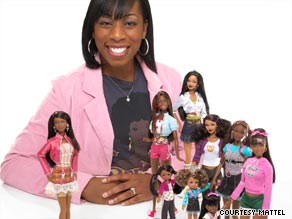
         Recently in class we talked about the issue of race, and its prevalence and effect on the world. You may have heard of the newest barbie released by Mattel: Grace, Tara, and Tichelle, the first african-american barbies. The first thing, however, was criticism of the dolls. Not of the fact that they were african-american, but that they weren't african-american enough. Whether it was that their figures weren't right, or that their hair, which is long, straight, and brown, doesn't represent what type of hair african-american women have. Whether or not you believe that the hair accurately represents the skin color of the doll, which is an extremely one-sided view which generalizes a whole group of people, there is one issue which seems to be forgotten. That is, that the doll was designed completely by an african-american women. I, for one, believe there is no one better to design a representation of an african-american women, then, you guessed it, an african-american woman. However, the question is not about the details of the doll, but the doll itself. Does the making of the doll represent a step forward in the acceptance of african-americans, or is it a forced product to respond to the people who cried foul at the lack of diversity in Barbie?

Sam Bradford

         Recently, the starting quarterback of the Oklahoma Sooners, Sam Bradford, hurt his soldier and is likely out for the rest of the season. The thing is, Bradford isn't just any quarterback for any college football team. The Sooners, who coming into the season were a contender for the national championship, have struggled with Bradford out and are now 3-3 on the season. Bradford, who as a sophomore last season won the Heisman trophy award, chose to come back to Oklahoma for his junior season instead of being a high (possibly the first overall) draft pick and getting paid millions of dollars. The combination of these has put a lot of scrutiny on the right shoulder of a certain Sam Bradford.

         Although some of the national attention has been focused on Oklahoma's title chances going down the drain, most has been focused on the future of the Heisman winner. At the end of last season, there was a lot of debate as to whether Bradford would come back or go to the pros. Obviously there were benefits to each choice, but in the end Bradford chose to come back, hoping to impress the scouts with another big year in college. But now that Bradford is injured, and his season likely over, the debate as to whether he made the right decision coming back has fired up. Whatever position you choose in the argument, the big question is: Why are we arguing about it. The decision was made long ago, and nothing will change that, but more importantly, it wasn't our decision in the first place, and its not our place to second guess it now. And this isn't an isolated incident: whenever a decision is made, there's always someone to second guess it. Why do people have such a fascination with second guessing things? Especially long after the decision has been made?

Tuesday, October 20, 2009

Windows vs. Mac

        When thinking of Mac vs. Windows, you might think of how bad Vista was, how funny those PC Mac commercials are, or how Macs never get viruses. Whatever you might think, its likely about how Mac is better. And when Windows 7 comes out in a few days, is there any way it will be able to recover from the hole it dug itself into with Vista?
       In case you've been in the stone age for the past few years, the last windows operating system, Vista, was met with terrible reviews. While Apple has been steadily improving its computers, Windows has had a bumpy ride. So that begs the question: even if Windows 7 is the best one yet, will it be able to compete with Mac? Or is the public perception of Windows already so low compared to Apple that it would take years to recover? But the fact is, the general opinion surrounding the new Windows release are very optimistic. It has gotten great reviews, although it still seems to be in the shadow of Vista's failure, always being compared to its predecessor. So, even if it is a very good operating system, will Windows 7 be able to compete with the likes of Leopard, the current Mac operating system, or will it forever be doomed to be in Vista's shadow?

Why go vegetarian? More like why not

          Recently in my Biology class, I was working on a project to create a law that would help the U.S. in some way, relating to a topic in biology. I chose to do mine on encouraging people to be a vegetarian. I'd always thought that people mostly became vegetarians to stop the slaughtering of animals. Turns out, there's a few more benefits: not only is it much better for you as a person (the risk of osteoporosis, high cholesterol, and cardiovascular disease is drastically smaller), it is cheaper (you can save as much as $4000 a year), and it is much better for the environment. How much better? Think about this: A single farm in Milford, Utah, which raises pigs, creates more waste than the entire city of Los Angeles. And this is a single farm. Now I'm no environmental freak, but that sounds like a pretty big deal.
          I understand that not everyone will come flocking to the non-meat eating side, but you'd think there would be a lot more. Personally, I know one vegetarian. And while I may not have 5000 friends on facebook, I know a lot of people. So why don't more people become vegetarians? Is is because not eating meat is too drastic of a change? But even then, you can still become a partial-vegetarian, eating no red meat, but still enjoying poultry and sea food, which has many of the same benefits, without all the sacrifice. When the question is no longer Why go veggie? but Why not go veggie?, why are so many people still chomping down on their bacon cheeseburgers?