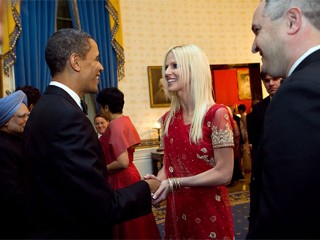
Last week, quite a controversy was started when Mr. and Mrs. Salahi snuck into President Obama's state dinner celebrating the leader of India. Which begs the question, with secret service at every entrance and exit, making sure that everyone who gets in is supposed to, and anyone who isn't invited stays out, how did the Salahi's get in. And how did they get a picture with the President before anyone noticed they weren't invited
Even after the event has ended, the Salahi's seem intent on making more of a story, demanding hundreds of thousands of dollars to give their story on the event on national television. And this isn't the first time the Salahi's have in the news for their actions. When Tareq Salahi and his family tried to sell their winery in 2006, he and his parents got into a legal battle over control of the winery, and the company filed for bankruptcy in February.
Apart from the Salahi's infamous actions, the Secret Service also isn't in an enviable position. Instead of the traditional and thorough check-in process that several invited guests had gone through in previous trips, the guests say that the check-in wasn't thorough or effective. The Secret Service briefly checked their IDs in the dark, they were made to wait outside in the rain before going through a make-shift metal detector, not even putting guests through any type of X-Ray machine. The story as a whole brings up two questions. One, how did two uninvited guests shake hands with the president at his state dinner? And two, whose actions are more embarrasing, the money-grubbing Salahi's, or the irresponsible secret service's?
Sunday, November 29, 2009
Sunday, November 22, 2009
More Global Warming Controversy
Recently, hundreds of e-mails were hacked from a server at a British University, leading to quite a stir among global warming skeptics. The e-mails contain discussions of using "tricks" to make temperature warming look more drastic, and derisive comments made about skeptics. Some climate experts, such as Dr. Kevin Trenberth, a climatologist for the National Center for Atmospheric Research, believes that the messages will show the "integrity of scientists". Dr. Michael Mann also responded that “Scientists often use the term ‘trick’ to refer to ‘a good way to deal with a problem,’ rather than something that is ‘secret.”
However, the e-mails also refer to global warming skeptics. A few of the e-mails written about Dr. Patrick Michaels muse about discrediting him by challenging his doctorate at the University of Wisconsin. "This shows these people are willing to bend rules and go after other people's reputations in serious ways," Michaels said. Do statements like Dr. Trenberth's, who said at one point that "The fact is that we can't account for the lack of warming at the moment and it is a travesty that we can't," make you believe that global warming scientists are truly trying to doctor the information they have collected before presenting it, or are the they simply showing "the integrity of scientists," as insisted by Dr. Trenberth?
Sunday, November 15, 2009
Iraq 2.0?
This week, Secretary of State Hillary Clinton said the U.S. mission in Afghanistan was not to rebuild the country, but rather to defeat our enemies, and give the Afghan people the tools to rule themselves. While this may seem like a good goal, and one we should should stick to, it feels to me a little too much like what were doing in Iraq. Our current goal in Iraq is to set up a government for the Iraqi people so that they can rule themselves, without having to rely on foreign aid or a cruel ruler. However, the constant conflict in Iraq between different people in the country has meant that we have been in the country much longer than we should be. It seems that unless the U.S. is very careful, it could end up fighting a long and expensive campaign in Afghanistan, similar to what it did in Iraq.

Clinton did say that "We believe that President [Hamid] Karzai and his government can do better," and that "our primary focus is on the security of the United States of America," but is it realistic to believe that the U.S. will be willing to step out of the country as soon as they take down Al Qaeda? In addition, Clinton was quick to point out things that the Karzai government needed to improve on. In the end, will Obama and the rest of the government be willing to step out of Afghanistan without rebuilding it in some form, like they did in Iraq?

Clinton did say that "We believe that President [Hamid] Karzai and his government can do better," and that "our primary focus is on the security of the United States of America," but is it realistic to believe that the U.S. will be willing to step out of the country as soon as they take down Al Qaeda? In addition, Clinton was quick to point out things that the Karzai government needed to improve on. In the end, will Obama and the rest of the government be willing to step out of Afghanistan without rebuilding it in some form, like they did in Iraq?
Thursday, November 12, 2009
Facebook saves the day
The loss of privacy because of the internet and technology is a hot topic of discussion. Obviously, there are many disadvantages to having less privacy, but there are positives too. In mid-october, a 19-year old Rodney Bradford was sitting at his computer at his father's house in New York. Twelve miles away, an armed robbery took place a minute later. Bradford, who also was under investigation for a previous robbery, found out he was being investigated by the police for the robbery, and turned himself in, confidant he would be found innocent of the crime. However, when he got to the station, a witness picked him out of a line-up, and he was charged with the robbery. A shocked Bradford was transferred to jail, where he spent almost two weeks before his father found him an alibi.
Bradford's father looked at his son's Facebook account, where he noticed he had updated his status just minutes before he allegedly committed the robbery. After the evidence was looked at, Bradford was found to have a rock-solid alibi, and the charges were dropped. In the big picture, Facebook could become a means of establishing alibis with the likes of phone records and video cameras, helping the judicial system to solve numerous cases. Although there is a definite loss of privacy using sites such as Facebook, there are also positives that are associated with them. What other ways could losing some of your privacy actually be beneficial? And does looking at the positives of sites such as Facebook change or reinforce your opinions on privacy issues presented by the internet and technology?
Tuesday, November 3, 2009
Free Speech?
On the topic of global warming, almost all scientists agree that there are changes going on in the environment. And many scientists and important political figures, such as Al Gore, believe that these changes are man-made, and require a drastic change in our attitude towards the environment. However, there are important scientists who believe otherwise, such as Dr. Patrick J Michaels, a former professor at UVA and former state climatologist of the state of Virginia, who believes that the climate change is caused less by humans than we thought, and that the changes caused could help the earth ecologically, rather than hurting it. Since he has made his position on global warming clear, Dr. Michaels' reports have been discredited by other scientists, and he has been under enormous pressure to change his views from scientists and politicians. Regardless of whether Dr. Michaels' view on global warming is the popular opinion, he should have free will to express his opinion on the topic, without having to fear repercussions from other scientists and politicians. This privelige is extended only to people who hold the majority view when it comes to global warming, not those who disagree.
This anecdote relates to a discussion we had in class recently, about whether poeple opposed to gay-marriage should have the right to sign a petition, without fear of their name becoming public knowledge. The fear of these people is that they will be bullied and intimidated because of their views, and they want to be able to express their views without fear of repercussions. However, people who don't support privacy in the matter believe that these people should stand by their opinions, and be willing to undergo bullying in order for their opinion to be heard. In my opinion, however, this view is extremely one sided. Just because people have a different opinion than yours doesn't mean you should be entitled to heckle, insult, and even bully them. If the names were being released just to encourage "civil conversations", I would have no problem with the names being released, and I doubt the petition-signers would either. However, there is evidence of people being harassed because of their opinions, which is unnacceptable and innapropriate. As a result, the names shouldn't be released, so people can express their opinions in safety, which should always be the case.
Sunday, November 1, 2009
Technophobia
Have you ever met someone who is afraid of driving their car to work everyday? Probably not. But people who are afraid to fly on an airplane? Much more common. Whether its John Madden, Tony Kornheiser, or your 12-year old cousin, chances are you've heard of someone who isn't comfortable getting into an airplane. Which begs the question, why? For every billion passenger kilometers, there are about .05 deaths on air travel. Cars on the other hand, have over three deaths per billion passenger miles. Bicycles? Over 44 deaths per billion passenger miles. And walking? Over 50 deaths. Which, when you boil it down, means that you are 60 times more likely to kick the bucket if you drive to Michigan for a family vacation than if you were to fly.
So why are people so afraid of a much more advanced, quicker, cheaper, and safer technology? And in general, why are people so hesitant to switch from their old, outdated technology to new, advanced ones? Whether its their not owning their own computer, or not wanting to fly on an airplanes, why are people so afraid of technology?
Subscribe to:
Posts (Atom)


